
Kaamos gets described in travel writing as either a spooky curiosity or a magical Instagram backdrop, and both miss what it’s actually like. It’s a specific, measurable astronomical phenomenon with its own texture and light — and it’s one of the recurring inspirations behind our prints. Here’s what it actually is.
Lue suomeksi? Lue tämä artikkeli suomeksi.
What kaamos technically is
Polar night — kaamos in Finnish — happens when the sun stays below the horizon for at least 24 consecutive hours straight, a phenomenon that only occurs above the Arctic Circle. It’s caused by the roughly 23.5-degree tilt of the Earth’s axis: during winter, the northern regions of Finland are angled away from the sun regardless of the time of day, so the sun simply doesn’t clear the horizon.
How long it actually lasts, and where
The duration depends entirely on how far north you are. In Utsjoki, Finland’s northernmost municipality, kaamos lasts around 51 days, roughly late November to mid-January. Ivalo, well above the Arctic Circle, gets about 27 days without sunrise. Rovaniemi, sitting right on the Arctic Circle, experiences roughly 30 days. Sodankylä, just south of that line, gets a much shorter stretch of around four days. Outside the Arctic Circle entirely — most of the country, including where our studio work happens — there’s no true kaamos, just shorter winter days.
Why it isn’t actually pitch black
This is the detail most people get wrong: even though the sun doesn’t rise, kaamos isn’t total darkness for 24 hours. Finnish Lapland sits close enough to the Arctic Circle that sunlight still reaches the upper atmosphere and scatters down, producing several hours of dim, blue-tinted twilight around midday even at the darkest point of the season. That soft, low blue light — locally called “the blue moment” — is a distinct visual quality that doesn’t really have an equivalent further south.
What it actually feels like
Rather than a single unbroken night, kaamos reads more like an extended dusk that never quite resolves into daylight or full dark. Snow cover amplifies what little ambient light there is, so landscapes can look almost luminous against the dim sky. It’s this specific combination — deep quiet, soft blue light, snow reflecting what little there is — that shows up again and again as inspiration in Nordic art and design, including in ours.
Where Njálla fits in
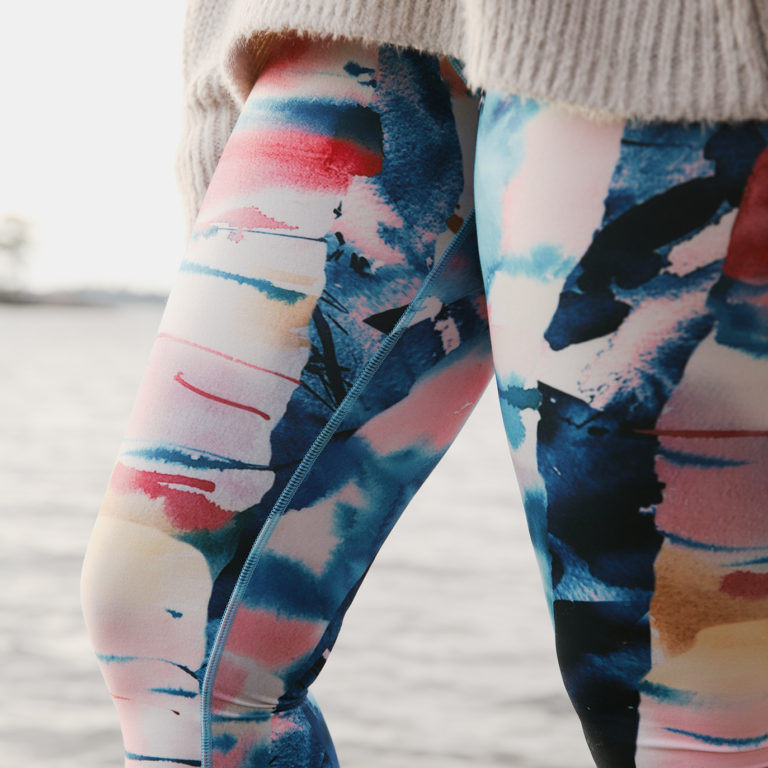
Several of our prints draw directly on kaamos: the low, blue-toned light, the hush of a landscape under snow, the sense of a season that slows everything down rather than shutting it off. It’s less about depicting a literal polar night scene and more about carrying that particular quality of light and quiet into fabric. You can read more about how a specific place or moment becomes a print in the story behind our prints.
Frequently Asked Questions
Is kaamos completely dark for 24 hours?
No — while the sun stays below the horizon, scattered sunlight in the upper atmosphere produces several hours of dim blue twilight around midday even during the darkest stretch, so it isn’t total darkness.
Does all of Finland experience kaamos?
No, only areas above the Arctic Circle in northern Finland experience true polar night. Southern and central Finland get shorter winter days with a proper sunrise and sunset, not kaamos in the technical sense.
How long does kaamos last in the darkest parts of Finland?
It varies by latitude — Finland’s northernmost municipality, Utsjoki, experiences roughly 51 days of polar night, while areas closer to the Arctic Circle’s edge, like Sodankylä, get only about four days.
Löydä Njállan mallisto
Tutustu ekologisiin joogaleggingseihimme ja joogatoppeihimme - kierrätysmateriaalia, käsintehtyä taidetta pohjoisesta luonnosta, eettisesti valmistettu. Etkö ole varma mistä aloittaa? Lue kattava ostajan oppaamme.

 Finnish
  English