
ECONYL shows up on swimwear and activewear tags as a sustainability win, but the actual process behind it is more specific — and more interesting — than most brands bother to explain. Here’s what regenerated nylon actually is, where it comes from, and how it differs from ordinary recycled polyester.
Lue suomeksi? Lue tämä artikkeli suomeksi.
Where the raw material comes from
ECONYL is a regenerated nylon developed by the Italian company Aquafil, first introduced in 2011. Its raw material is discarded nylon waste — most notably fishing nets recovered from oceans and aquaculture operations, alongside other nylon waste like carpet flooring. The world’s oceans hold an enormous amount of discarded fishing net, much of it “ghost gear” that keeps trapping marine life long after it’s lost or abandoned. Diverting that material into new fiber pulls it directly out of that cycle.
How the regeneration process actually works
Unlike the mechanical recycling used for most recycled polyester, ECONYL uses a chemical regeneration process: waste nylon is collected, cleaned, and shredded, then depolymerized to break it back down to its raw nylon building blocks, then re-polymerized and spun into new yarn. Because this restores the material to its original molecular state rather than just melting and reshaping it, the resulting fiber can reportedly match the quality of virgin nylon — without needing new petroleum-based input.
How this differs from recycled polyester (rPET)
Recycled polyester is typically produced through mechanical recycling — plastic is melted down and re-spun, a process that’s efficient but degrades fiber quality slightly with each cycle, which is why rPET can’t be recycled indefinitely at the same quality. Chemical regeneration, the process ECONYL uses, is more resource- and cost-intensive but allows repeated, closed-loop recycling without the same quality loss. Put simply: rPET solves the plastic-bottle waste problem efficiently and affordably; ECONYL-style regeneration solves a different waste problem (ocean fishing nets) with a more intensive process.
Does it perform differently on the mat?
Nylon fiber, regenerated or virgin, tends to hold slightly more moisture than polyester (roughly 4–5% of its weight) — meaning it dries a bit slower — but offers strong stretch recovery and abrasion resistance, which is part of why it shows up often in swimwear and heavy-use gear. It’s a genuine performance trade-off rather than a downgrade: polyester dries faster, nylon recovers its shape and resists wear slightly better.
Where Njálla fits in
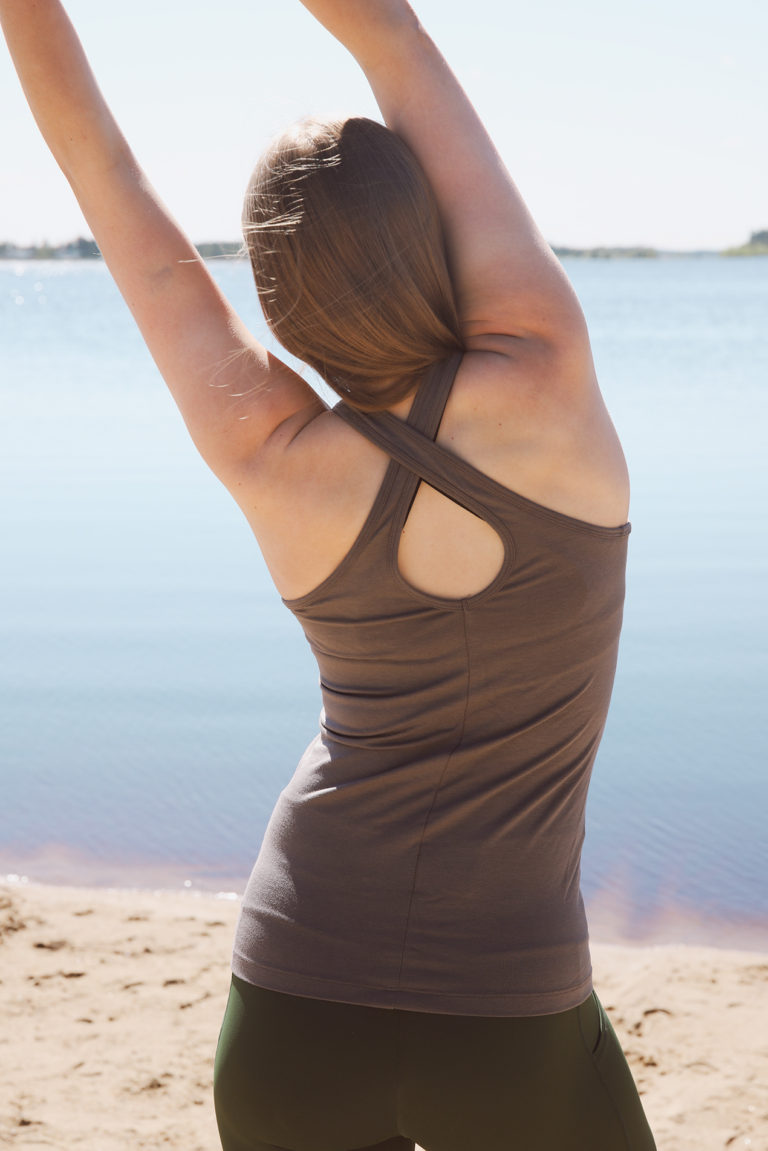
Our leggings, tops, and sports bras use recycled polyester rather than regenerated nylon, chosen specifically for the moisture-wicking and quick-drying performance that yoga and everyday movement actually need, at a price point that keeps sustainable activewear accessible rather than a luxury purchase. That’s not a claim that recycled polyester is objectively “better” than regenerated nylon in every sense — it’s the material that fits what our leggings are built to do. You can read more about how recycled polyester compares to recycled nylon in our fiber-by-fiber breakdown.
Frequently Asked Questions
Is ECONYL the same as recycled polyester?
No. ECONYL is a specific regenerated nylon made through chemical depolymerization, mostly from fishing nets and other nylon waste. Recycled polyester (rPET) is a different fiber, usually made from plastic bottles through mechanical recycling — the two come from different raw materials and different processes.
Can ECONYL be recycled again after use?
Aquafil states the chemical regeneration process can be repeated, since it restores the material to its raw building blocks rather than degrading it with each cycle the way mechanical recycling does — though in practice, this depends on collection infrastructure actually existing to gather the material again.
Does regenerated nylon perform as well as virgin nylon?
By design, yes — because the chemical process restores the nylon to its original molecular state, the resulting fiber is intended to match virgin nylon’s quality and performance rather than being a lower-grade substitute.
Löydä Njállan mallisto
Tutustu ekologisiin joogaleggingseihimme ja joogatoppeihimme - kierrätysmateriaalia, käsintehtyä taidetta pohjoisesta luonnosta, eettisesti valmistettu. Etkö ole varma mistä aloittaa? Lue kattava ostajan oppaamme.
 Finnish
  English